

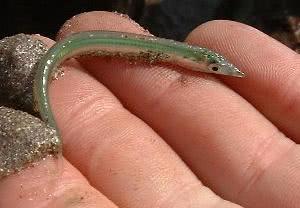
There are several species of sand eel but the two most likely to be encountered on the seashore will be the lesser and greater sand eels, Ammodytes tobianus and Hyperoplus lanceolatus, respectively. Their bodies are elongated and eel-like with a forked tail. The lower jaws project further than the upper jaw and the scales on the body are so small that they are not obvious.
They get their name for lying buried in sand, often on the lower shore, with the head exposed. The lesser (pictured above), is up to 20 cm in length whilst the greater can be almost double. They feed on any animals associated with sandy shores, especially crustaceans. They can live for 4 or 5 years.
Sand eels are a very important diet for certain seabirds, e.g. puffins and other auks. Any factor affecting sand eel density will be expected to cause repurcussions amongst seabird populations.
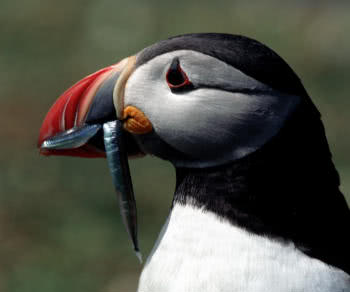
Puffin with sand eels in the beak
Looking for a next step?
The FSC offers a range of publications, courses for schools and colleges and courses for adults, families and professionals that relate to the seashore environment. Why not find
out more about the FSC?

FEEDBACK
Do you have any questions?
Copyright © 2008 Field Studies Council

Creative Commons Attribution-Noncommercial-No Derivative Works 3.0 Licence .
Site Statistics by Opentracker